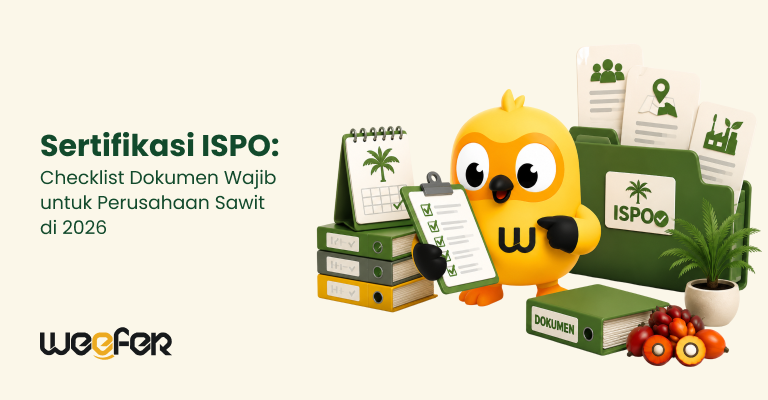
Sertifikasi ISPO: Checklist Dokumen Wajib untuk Perusahaan Sawit di 2026
ISPO (Indonesian Sustainable Palm Oil) adalah sertifikasi keberlanjutan sawit yang diwajibkan pemerintah Indonesia, berbeda dari RSPO yang sifatnya sukarela.



Weefer implements SAP S/4HANA Public Cloud Edition, an ERP (Enterprise Resource Planning) system from SAP, for palm oil and rubber companies in Indonesia. This system connects estate, mill, procurement, inventory, finance, and reporting data, including integration with weighbridge and field timesheets, in one platform.

Field costs and revenue, including weighbridge and mandor timesheet data, don’t automatically flow into financial reports.

Teams have to manually match production, stock, and purchasing data every period.

Tonnage per seed variety, extraction rate (OER), and blocks needing productivity improvement are hard to monitor without an automatically updating dashboard.

Management can’t accurately compare cost per estate, block, or planting season vs. harvest season.

Purchase approval and spare part usage processes aren’t always recorded properly.

Equipment maintenance data isn’t connected to spare part availability data.

Data scattered across many systems makes the audit process and history tracking slower.

Compliance with ISPO, RSPO, and EUDR (the EU deforestation regulation effective December 2026) all require proof of geolocation and land legality, data that’s difficult to prepare without an integrated system.
Field costs and revenue, including weighbridge and mandor timesheet data, don’t automatically flow into financial reports.
Teams have to manually match production, stock, and purchasing data every period.
Tonnage per seed variety, extraction rate (OER), and blocks needing productivity improvement are hard to monitor without an automatically updating dashboard.
Management can’t accurately compare cost per estate, block, or planting season vs. harvest season.
Purchase approval and spare part usage processes aren’t always recorded properly.
Equipment maintenance data isn’t connected to spare part availability data.
Data scattered across many systems makes the audit process and history tracking slower.
Compliance with ISPO, RSPO, and EUDR (the EU deforestation regulation effective December 2026) all require proof of geolocation and land legality, data that’s difficult to prepare without an integrated system.
SAP S/4HANA Public Cloud Edition manages the core processes of a plantation company, including procurement, inventory, finance, sales, asset management, and reporting, in one ERP system. Data from estates, mills, warehouses, and head office, including weighbridge and mandor timesheet integration, flows into the same single data source.
Select a capability below to see how SAP S/4HANA Public Cloud supports the specific needs of plantation operations.
SAP S/4HANA Public Cloud Edition supports a tiered plantation operational structure, Estate as location, Area as operational division, and Block based on planting time, so data stays consistent from the field to head office reporting.
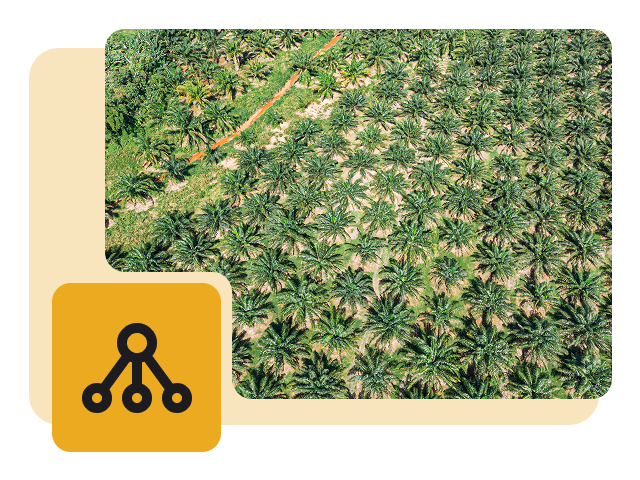
Tonnage, seed variety, and harvest yield data per block are available in real time, helping management identify areas needing productivity improvement faster.

Direct integration with the weighbridge and a mobile app for mandor daily logs ensures harvest and work activity data enters the system automatically and accurately, straight from the field.

An accounting structure tailored for agribusiness enables cost comparison across estates, blocks, and periods, including planting season versus harvest season.

A GIS-based dashboard provides location and land history visibility needed for internal audits as well as external regulations like ISPO, RSPO, and EUDR.
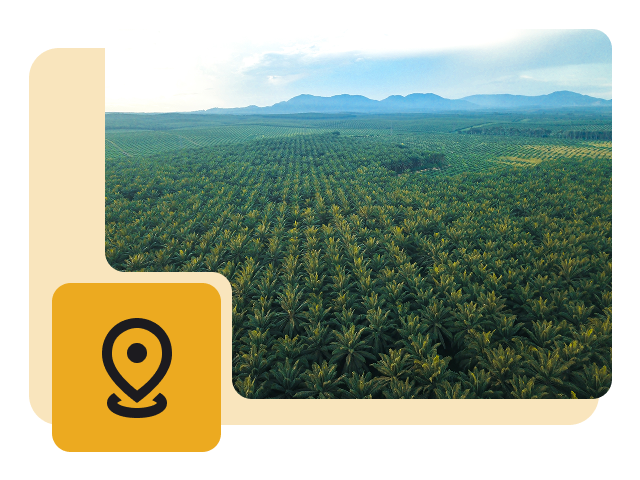
Harvest data from estates connects directly to mill production processes, so extraction rate and production efficiency can be monitored from the same system.
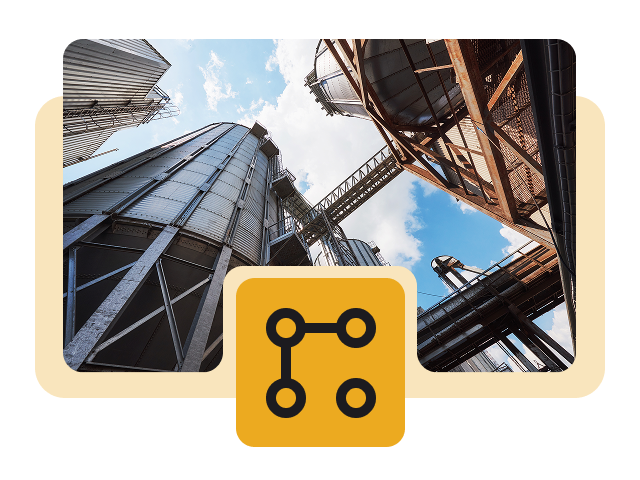
Purchasing and usage of fertilizer, chemicals, fuel, and spare parts is recorded and connected to inventory in real time, with transparent approvals.

Financial reports from various estates and entities can be automatically consolidated, speeding up closing and reporting to central management.

SAP S/4HANA Public Cloud Edition supports a tiered plantation operational structure, Estate as location, Area as operational division, and Block based on planting time, so data stays consistent from the field to head office reporting.
Tonnage, seed variety, and harvest yield data per block are available in real time, helping management identify areas needing productivity improvement faster.
Direct integration with the weighbridge and a mobile app for mandor daily logs ensures harvest and work activity data enters the system automatically and accurately, straight from the field.
An accounting structure tailored for agribusiness enables cost comparison across estates, blocks, and periods, including planting season versus harvest season.
A GIS-based dashboard provides location and land history visibility needed for internal audits as well as external regulations like ISPO, RSPO, and EUDR.
Harvest data from estates connects directly to mill production processes, so extraction rate and production efficiency can be monitored from the same system.
Purchasing and usage of fertilizer, chemicals, fuel, and spare parts is recorded and connected to inventory in real time, with transparent approvals.
Financial reports from various estates and entities can be automatically consolidated, speeding up closing and reporting to central management.
SAP S/4HANA Public Cloud supports plantation operational needs from two angles: the day-to-day business functions, and the specific characteristics of each commodity.

Monitor production and yield data per estate down to block level, including tonnage per seed variety, for consistent operational performance

Connect mill data (palm oil mill for palm oil) with inventory, procurement, quality, and finance

Manage purchasing, vendors, spare parts, fertilizer, chemicals, and fuel with recorded approvals

Connect operational data to finance to see cost per block, margin, and budgeting across planting-harvest seasons accurately

Manage assets, vehicles and heavy equipment, work orders, spare parts, and maintenance to control downtime

Unify data from many estates and blocks in a GIS-based dashboard for land location and productivity visibility

Provide approval history and land geolocation data for audit needs and regulations like ISPO, RSPO, and EUDR

Connect weighbridge data and mobile mandor daily log apps directly to the system, without repeated manual entry

Monitor production and yield data per estate down to block level, including tonnage per seed variety, for consistent operational performance

Connect mill data (palm oil mill for palm oil) with inventory, procurement, quality, and finance
Manage purchasing, vendors, spare parts, fertilizer, chemicals, and fuel with recorded approvals
Connect operational data to finance to see cost per block, margin, and budgeting across planting-harvest seasons accurately
Manage assets, vehicles and heavy equipment, work orders, spare parts, and maintenance to control downtime
Unify data from many estates and blocks in a GIS-based dashboard for land location and productivity visibility

Provide approval history and land geolocation data for audit needs and regulations like ISPO, RSPO, and EUDR

Connect weighbridge data and mobile mandor daily log apps directly to the system, without repeated manual entry
Multi-estate, mill, CPO (Crude Palm Oil), inventory, and complex costing, with a planting-to-harvest cycle of up to 5 years from the immature (TBM) to mature (TM) phase
Integrating estate, mill, and finance data in one system, with cost-per-block visibility starting from the immature phase
Latex collection, production of TSR (Technically Specified Rubber) and RSS (Ribbed Smoked Sheet), quality control, and export processes, with a similarly long planting cycle
Supply chain and quality tracking from the field to export-ready TSR/RSS products, with yield-per-block dashboards
Multi-estate, mill, CPO (Crude Palm Oil), inventory, and complex costing, with a planting-to-harvest cycle of up to 5 years from the immature (TBM) to mature (TM) phase
Integrating estate, mill, and finance data in one system, with cost-per-block visibility starting from the immature phase
Latex collection, production of TSR (Technically Specified Rubber) and RSS (Ribbed Smoked Sheet), quality control, and export processes, with a similarly long planting cycle
Supply chain and quality tracking from the field to export-ready TSR/RSS products, with yield-per-block dashboards
Weefer has been an official SAP partner in Indonesia since 2017, experienced in implementing SAP S/4HANA Public Cloud Edition across various industries in Indonesia. The success of a SAP S/4HANA Public Cloud Edition implementation depends on business process mapping, data readiness, system configuration, and user training, not just on purchasing a software license.
Implementation runs through five sequential stages, from needs assessment to post-go-live support.
Mapping business processes, pain points, and implementation priorities.
Determining modules, workflow, integration, and implementation scope.
Configuring SAP S/4HANA Public Cloud Edition according to business processes and data needs.
Preparing initial data and training the team to use the system.
Supporting the system usage transition and optimizing after go-live.

VP of ERP & Project Lead
Experience
20+ years in the ERP industry, handling 50+ enterprise-scale SAP projects across Southeast Asia.
Specialization
SAP S/4HANA Public Cloud transformation & program management for multi-location companies across various industry sectors.

SAP Solution Specialist, S/4HANA Public Cloud
Experience
S/4HANA Public Cloud Edition specialist with a track record of implementation across various industry sectors on a multi-location basis.
Specialization
SAP S/4HANA Public Cloud deployment and multi-location system integration.
Weefer Unified Growth Suite for SAP GROW Fast combines Core ERP (SAP S/4HANA Public Cloud Edition) for estate and mill operations, and Core HR (SAP SuccessFactors Employee Central) for managing field and seasonal labor, in one ready-to-use package with Fixed Time, Fixed Scope, and Fixed Price from the start.
Learn MoreThis package is separate from the general SAP S/4HANA Public Cloud Edition consultation for plantation on this page, ideal if you already know you want to start with Core ERP + Core HR with a fixed timeline and budget.
Weefer Unified Growth Suite for SAP GROW Fast combines Core ERP (SAP S/4HANA Public Cloud Edition) for estate and mill operations, and Core HR (SAP SuccessFactors Employee Central) for managing field and seasonal labor, in one ready-to-use package with Fixed Time, Fixed Scope, and Fixed Price from the start.
Learn MoreThis package is separate from the general SAP S/4HANA Public Cloud Edition consultation for plantation on this page, ideal if you already know you want to start with Core ERP + Core HR with a fixed timeline and budget.
Discuss your company’s ERP needs with the Weefer team. We help map business processes, integration needs, and module priorities for your plantation operations.
Yes. SAP S/4HANA Public Cloud Edition is suitable for plantation companies with complex, multi-location processes, and a need for integrated finance, procurement, inventory, asset, and reporting.
Yes. Managing estate and mill data requires process design and integration tailored to the company’s operational needs.
Yes. SAP S/4HANA Public Cloud Edition is used as the core ERP, and its implementation is tailored to each commodity’s processes, including estate, area, and block structures.
SAP S/4HANA Public Cloud Edition can serve as the data infrastructure to support the land traceability and reporting needed for ISPO, RSPO, and EUDR. Full compliance still requires land legality processes and documentation outside the ERP system.
SAP S/4HANA Public Cloud Edition runs on the cloud and requires an internet connection for data synchronization. For locations with limited connectivity, field data entry can be designed to support a delayed-sync mode according to the agreed integration design.
Duration depends on scope, number of modules, number of locations, data condition, and integration complexity.
In many cases, yes. The implementation team needs to assess the existing system and integration needs.
Companies need to prepare business process mapping, master data, organizational structure, reporting needs, and the internal team involved.



















Your Digital Transformation Partner - Berawal pada tahun 2004, Weefer bertumbuh menjadi Pioneer Digital Transformation Partner dengan proven track record dalam implementasi solusi teknologi untuk perusahaan skala enterprise di Indonesia.

 Batam
Batam